
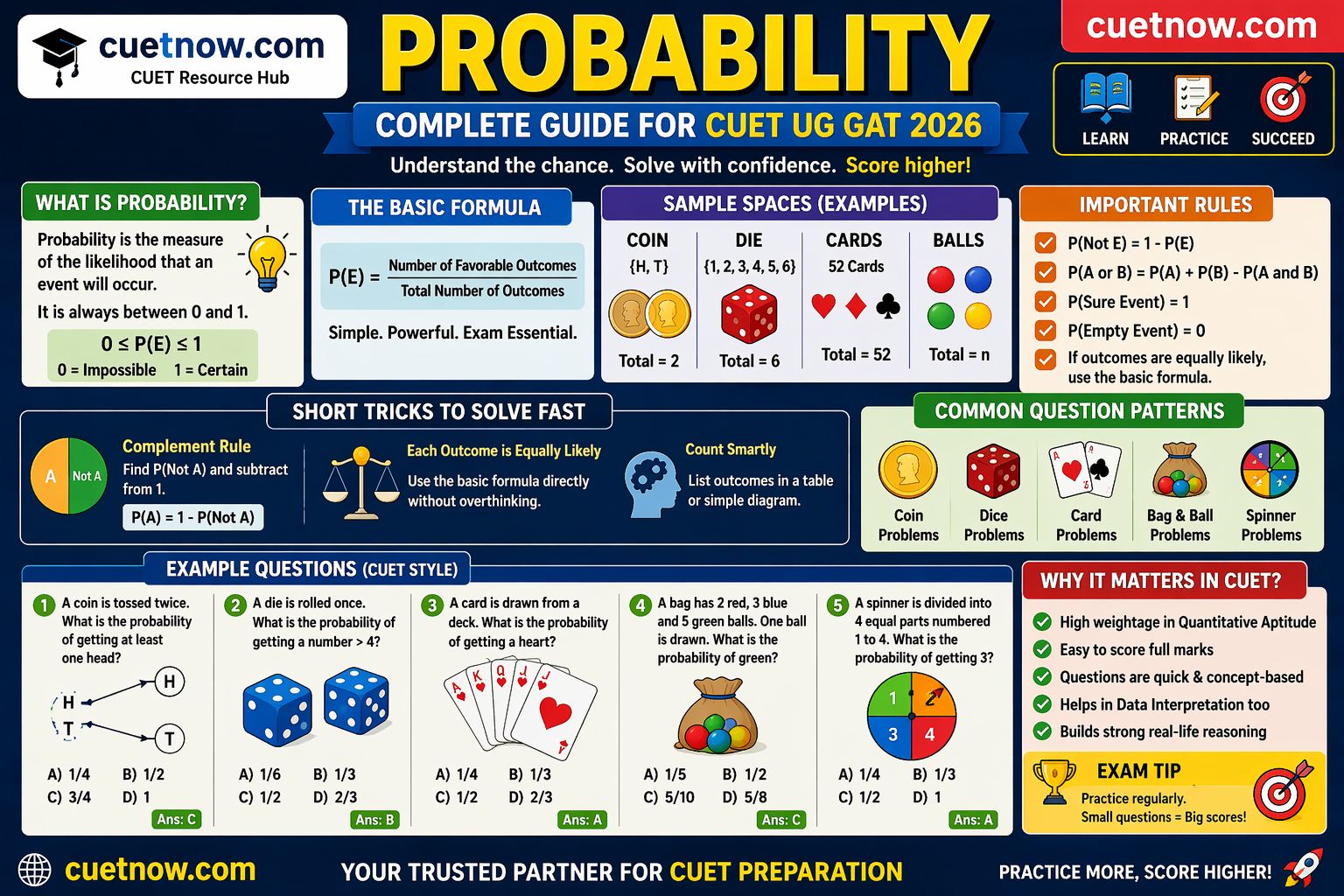
Probability for CUET GAT 2026
Introduction to Probability for CUET UG GAT 2026
Probability For CUET UG GAT 2026: Probability is one of the most important and scoring topics in the CUET UG GAT 2026 Quantitative Aptitude section. It helps students predict the likelihood of events and solve real-life problems involving chance, risk, and uncertainty.
In CUET, probability questions are usually easy to moderate and can be solved quickly using formulas and logical counting methods. With proper practice, students can score full marks from this topic.
Probability is widely used in:
- Games and sports
- Weather forecasting
- Insurance and finance
- Data science and statistics
- Decision making
What is Probability?
Probability is a measure of the chance that an event will occur.
Basic Formula
Probability =
Number of favorable outcomes / Total number of possible outcomes
Probability Range
0 ≤ Probability ≤ 1
Where:
0 → Impossible event
1 → Certain event
Important Probability Formulas for CUET
- P(E) = Favorable outcomes / Total outcomes
- P(Not E) = 1 − P(E)
- P(A or B) = P(A) + P(B) − P(A and B)
- Probability of sure event = 1
- Probability of impossible event = 0
- Number of outcomes when tossing coin n times = 2ⁿ
- Number of outcomes when rolling dice n times = 6ⁿ
Common Patterns of Probability Questions in CUET
Most questions come from these patterns:
- Coin problems
- Dice problems
- Card problems
- Bag and ball problems
- Complement probability
- Simple event probability
- Multiple event probability
Short Tricks to Solve Probability Questions Fast
Trick 1: Use Complement Rule
Instead of calculating directly, find:
P(Not Event)
Then subtract from 1.
Example:
Probability of at least one head in 2 tosses
P(No head) = 1/4
So,
P(At least one head)
= 1 − 1/4
= 3/4
Trick 2: Memorize Total Outcomes
Coin → 2
Dice → 6
Cards → 52
This saves time in exams.
Trick 3: Use Symmetry
If outcomes are equally likely, probability is evenly distributed.
Example:
Odd number on dice
3 outcomes
So probability =
3/6
= 1/2
Probability Important MCQs for CUET UG GAT 2026
(Actual Exam Pattern with Step-by-Step Solutions)
Q 4414) Selecting a Student
Question:
In a class of 20 students, 12 are boys and 8 are girls. If one student is selected at random, what is the probability that the student is a girl?
(A) 2/4
(B) 1/5
(C) 2/5
(D) 1/4
Answer: (C) 2/5
Step-by-Step Solution:
Total students = 20
Girls = 8
Probability
= Favorable outcomes / Total outcomes
P = 8 / 20 = 2 / 5
Q 4415) Tossing Two Coins
Question:
Two coins are tossed simultaneously. What is the probability of getting at least one head?
(A) 3/5
(B) 3/4
(C) 2/5
(D) 2/3
Answer: (B) 3/4
Step-by-Step Solution:
Sample space:
HH
HT
TH
TT
Total outcomes = 4
At least one head outcomes:
HH
HT
TH
Favorable outcomes = 3
P = 3/4
Q 4416) Choosing a Card
Question:
A card is drawn from a standard deck of 52 cards. Find the probability that the card drawn is a face card.
(A) 3/13
(B) 3/17
(C) 2/13
(D) 2/17
Answer: (A) 3/13
Step-by-Step Solution:
Face cards =
Jack, Queen, King
Each suit has 3 face cards
Total face cards
= 3 × 4
= 12
Total cards
= 52
P = 12/52 = 3/13
Q 4417) Selecting a Number
Question:
A number is selected randomly from 1 to 15. Find the probability that the number is divisible by 5.
(A) 2/5
(B) 2/3
(C) 2/7
(D) 1/5
Answer: (D) 1/5
Step-by-Step Solution:
Numbers divisible by 5:
5, 10, 15
Total favorable outcomes = 3
Total numbers = 15
P = 3/15 = 1/5
Q 4418) Bag of Balls
Question:
A bag contains 4 red, 3 blue, and 3 green balls. One ball is drawn at random. Find the probability of drawing a green ball.
(A) 3/8
(B) 3/10
(C) 3/7
(D) 3/5
Answer: (B) 3/10
Step-by-Step Solution:
Green balls = 3
Total balls
= 4 + 3 + 3
= 10
P = 3/10
Q 4419) Even Number from Dice
Question:
A die is rolled once. What is the probability of getting an even number greater than 2?
(A) 2/3
(B) 3/7
(C) 1/3
(D) 3/5
Answer: (C) 1/3
Step-by-Step Solution:
Even numbers greater than 2:
4, 6
Favorable outcomes = 2
Total outcomes = 6
P = 2/6 = 1/3
Q 4420) Selecting a Letter
Question:
A letter is selected at random from the word MATHEMATICS. Find the probability that the selected letter is a vowel.
(A) 4/11
(B) 4/9
(C) 4/7
(D) 4/5
Answer: (A) 4/11
Step-by-Step Solution:
Letters in MATHEMATICS
= 11
Vowels:
A, E, A, I
Total vowels = 4
P = 4/11
Q 4421) Student Attendance
Question:
Out of 30 students, 18 attended a seminar. If one student is selected randomly, find the probability that the student attended the seminar.
(A) 3/7
(B) 3/5
(C) 3/9
(D) 3/8
Answer: (B) 3/5
Step-by-Step Solution:
Attended students = 18
Total students = 30
P = 18/30 = 3/5
Q 4422) Selecting a Card
Question:
A card is drawn from a deck. Find the probability that the card is neither a king nor a queen.
(A) 11/13
(B) 11/9
(C) 9/7
(D) 7/5
Answer: (A) 11/13
Step-by-Step Solution:
Kings = 4
Queens = 4
Total unwanted cards
= 8
Cards neither king nor queen
= 52 − 8
= 44
P = 44/52 = 11/13
Q 4423) Choosing a Day
Question:
A day of the week is chosen randomly. Find the probability that the chosen day is a weekend.
(A) 2/9
(B) 2/7
(C) 2/5
(D) 2/3
Answer: (B) 2/7
Step-by-Step Solution:
Total days in week
= 7
Weekend days
= Saturday, Sunday
Favorable outcomes = 2
P = 2/7
Q 4424) Selecting a Number
Question:
A number is chosen randomly from 1 to 20. Find the probability that the number is a prime number.
(A) 2/7
(B) 2/9
(C) 2/5
(D) 2/3
Answer: (C) 2/5
Step-by-Step Solution:
Prime numbers between 1 and 20:
2, 3, 5, 7, 11, 13, 17, 19
Total primes = 8
Total numbers = 20
P = 8/20 = 2/5
Q 4425) Drawing a Marble
Question:
A jar contains 5 white and 7 black marbles. One marble is drawn. Find the probability that the marble is black.
(A) 7/9
(B) 7/13
(C) 7/11
(D) 7/12
Answer: (D) 7/12
Step-by-Step Solution:
Black marbles = 7
Total marbles
= 5 + 7
= 12
P = 7/12
Q 4426) Selecting a Student
Question:
In a group of 40 students, 25 like mathematics and the rest like science. Find the probability that a randomly selected student likes science.
(A) 3/10
(B) 3/8
(C) 3/7
(D) 3/5
Answer: (B) 3/8
Step-by-Step Solution:
Students who like science
= 40 − 25
= 15
Total students = 40
P = 15/40 = 3/8
Q 4427) Tossing Three Coins
Question:
Three coins are tossed simultaneously. Find the probability of getting exactly two heads.
(A) 3/10
(B) 3/7
(C) 3/11
(D) 3/8
Answer: (D) 3/8
Step-by-Step Solution:
Sample space:
HHH
HHT
HTH
THH
HTT
THT
TTH
TTT
Total outcomes = 8
Exactly two heads outcomes:
HHT
HTH
THH
Favorable outcomes = 3
P = 3/8
Q 4428) Choosing a Letter
Question:
A letter is chosen from the word PROBABILITY. Find the probability that the letter selected is B.
(A) 2/13
(B) 2/9
(C) 2/11
(D) 2/7
Answer: (C) 2/11
Step-by-Step Solution:
Letters in PROBABILITY
= 11
Letter B appears
= 2 times
P = 2/11
Q 4429) Selecting a Card
Question:
A card is drawn from a deck. Find the probability that the card drawn is a heart.
(A) 1/4
(B) 3/4
(C) 5/7
(D) 5/9
Answer: (A) 1/4
Step-by-Step Solution:
Hearts in deck
= 13
Total cards
= 52
P = 13/52 = 1/4
Q 4430) Choosing a Number
Question:
A number is selected randomly from 1 to 12. Find the probability that the number is a multiple of 4.
(A) 2/5
(B) 1/4
(C) 3/5
(D) 2/3
Answer: (B) 1/4
Step-by-Step Solution:
Multiples of 4:
4, 8, 12
Total favorable outcomes = 3
Total numbers = 12
P = 3/12 = 1/4
Q 4431) Selecting a Ball
Question:
A bag contains 6 red and 4 blue balls. Two balls are drawn one at a time without replacement. Find the probability that both balls are red.
(A) 2/3
(B) 2/5
(C) 1/3
(D) 3/5
Answer: (C) 1/3
Step-by-Step Solution:
Total balls = 10
First red probability
= 6 / 10
Remaining red balls
= 5
Remaining total balls
= 9
Second red probability
= 5 / 9
Final probability
P = (6/10) × (5/9) = 30 / 90 = 1/3
Q 4432) Selecting a Number
Question:
A number is chosen from 1 to 10. Find the probability that the number is odd.
(A) 1/2
(B) 2/3
(C) 3/5
(D) 2/7
Answer: (A) 1/2
Step-by-Step Solution:
Odd numbers:
1, 3, 5, 7, 9
Total favorable outcomes = 5
Total numbers = 10
P = 5/10 = 1/2
Q 4433) Selecting a Card
Question:
A card is drawn from a deck. Find the probability that the card drawn is an ace.
(A) 1/10
(B) 1/11
(C) 1/12
(D) 1/13
Answer: (D) 1/13
Step-by-Step Solution:
Aces in deck
= 4
Total cards
= 52
P = 4/52 = 1/13
Q 4434) Choosing a Day
Question:
A day is selected randomly from a year. Find the probability that the day is Sunday.
(Assume 365 days in a year)
(A) 52/365
(B) 26/365
(C) 13/365
(D) None of these
Answer: (A) 52/365
Step-by-Step Solution:
Total Sundays in year
= 52
Total days
= 365
P = 52/365
Q 4435) Selecting a Card
Question:
A card is drawn from a deck. Find the probability that the card is a number card (2–10).
(A) 9/12
(B) 9/13
(C) 9/11
(D) 9/10
Answer: (B) 9/13
Step-by-Step Solution:
Number cards per suit
= 9
Total suits = 4 and Total number cards = 9 × 4 = 36
Total cards = 52
P = 36/52 = 9/13
Q 4436) Selecting a Student
Question:
In a class of 50 students, 30 are boys. Find the probability that a randomly selected student is not a boy.
(A) 4/5
(B) 3/5
(C) 3/4
(D) 2/5
Answer: (D) 2/5
Step-by-Step Solution:
Girls
= 50 − 30
= 20
Total students = 50
P = 20/50 = 2/5
Q 4437) Tossing a Die Twice
Question:
A die is thrown twice. Find the probability that the sum of numbers is 7.
(A) 1/5
(B) 1/6
(C) 3/5
(D) 2/3
Answer: (B) 1/6
Step-by-Step Solution:
Possible pairs:
(1,6)
(2,5)
(3,4)
(4,3)
(5,2)
(6,1)
Favorable outcomes = 6
Total outcomes
= 6 × 6
= 36
P = 6/36 = 1/6
Q 4438) Selecting a Number
Question:
A number is selected from 1 to 8. Find the probability that the number is greater than 5.
(A) 3/7
(B) 3/5
(C) 3/8
(D) 3/11
Answer: (C) 3/8
Step-by-Step Solution:
Numbers greater than 5:
6, 7, 8
Favorable outcomes = 3
Total numbers = 8
P = 3/8
Why Probability is Important for CUET UG GAT 2026
- High scoring topic
- Frequently asked in exams
- Easy to understand
- Saves time in the exam
- Used in real-life decision making
- Helps in logical reasoning
- Builds strong quantitative skills
Expected Questions in CUET: 1 to 2 questions are usually asked.
Difficulty Level:
Easy to Moderate
Frequently Asked Questions (FAQs)
1. Is probability important for CUET UG GAT 2026?
Yes. Probability is a high-weightage and scoring topic in Quantitative Aptitude.
2. How many probability questions come in CUET?
Usually:
1 to 2 questions
3. What is the basic formula of probability?
Probability
= Favorable outcomes / Total outcomes
4. Is probability easy for CUET?
Yes. Most probability questions are simple and formula-based.
5. Can I skip probability for CUET?
Not recommended. It is one of the easiest scoring topics.
Conclusion
Probability is one of the most important and scoring topics for CUET UG GAT 2026. With basic formulas, pattern recognition, and regular practice, students can solve probability questions quickly and accurately.
Focus on:
- Understanding formulas
- Practicing MCQs
- Using short tricks
- Managing time
Mastering probability can significantly improve your overall CUET score.
